Sunday, 26 January 2014

Toyo Ito

Toyo Ito, born on June 1st 1941 is a Japanese architect known for creating conceptual architecture. He has been called one of the world`s most innovative and influential architects.


From 1965 to 1969 he was working fro Kiyonori Kikutake Architecture and Associates. In 1971 he started his own studio in Tokyo named Urbot (short for The Urban Robot) and in 1979 he changed the name to Toyo Ito and Associates.


In his early career he constructed a large number of private house projects in the urban life in Japan such as White U  (1976) and Silver Hut (1984). The silver Hut is known for its conceptual design. His architecture career began with a project for his sitter called The U House located in the centre of Tokyo. The U House contained windows on the inside facing a courtyard instead of the typical outward-facing windows. This was the first experiment for Ito with the ways that light entered the buildings. He also used this concept of windows for the Silver Hut which was located in Nakona, Tokyo.


The U House Project (1976)


The Silver Hut (1984)


The Tower of Winds (1986) and Egg of Winds (1991) are interactive landmarks in public spaces resulting from a creative interpretation of contemporary technical possibility. Their function is to exhaust air out from the underground system below. During the day they appear as if  they are perforated aluminium structures but during the night it appears as if it is dissolved by the use of computer-controlled light system. The light forms an interactive display representing measured data such as noise levels in their surrounding vicinity.


The Tower of Winds  (1986)


The Sendai Mediatheque  is one of Ito’s most iconic buildings. An other well known architecture building made by Ito is the Serpentine Gallery Pavilion (2002). In this project he worked together with Cecil Balmond, Arup. This appeared to be an extremely complex random pattern which was in fact derived from an algorithm of cubes that expanded as it rotated. The shapes that were used for this building (triangle and trapezoids) which are transparent gave them a sense of infinitely repeated motion.


Sendai Mediatheque - Toyo Ito


Serpentine Gallery Pavilion

Toyo Ito was given the Pritzkei Price in 2013. A member of the Pritzkei jury for 2013 said that throughout his career Ito was working to push the boundaries of architecture and to achieve that goal.
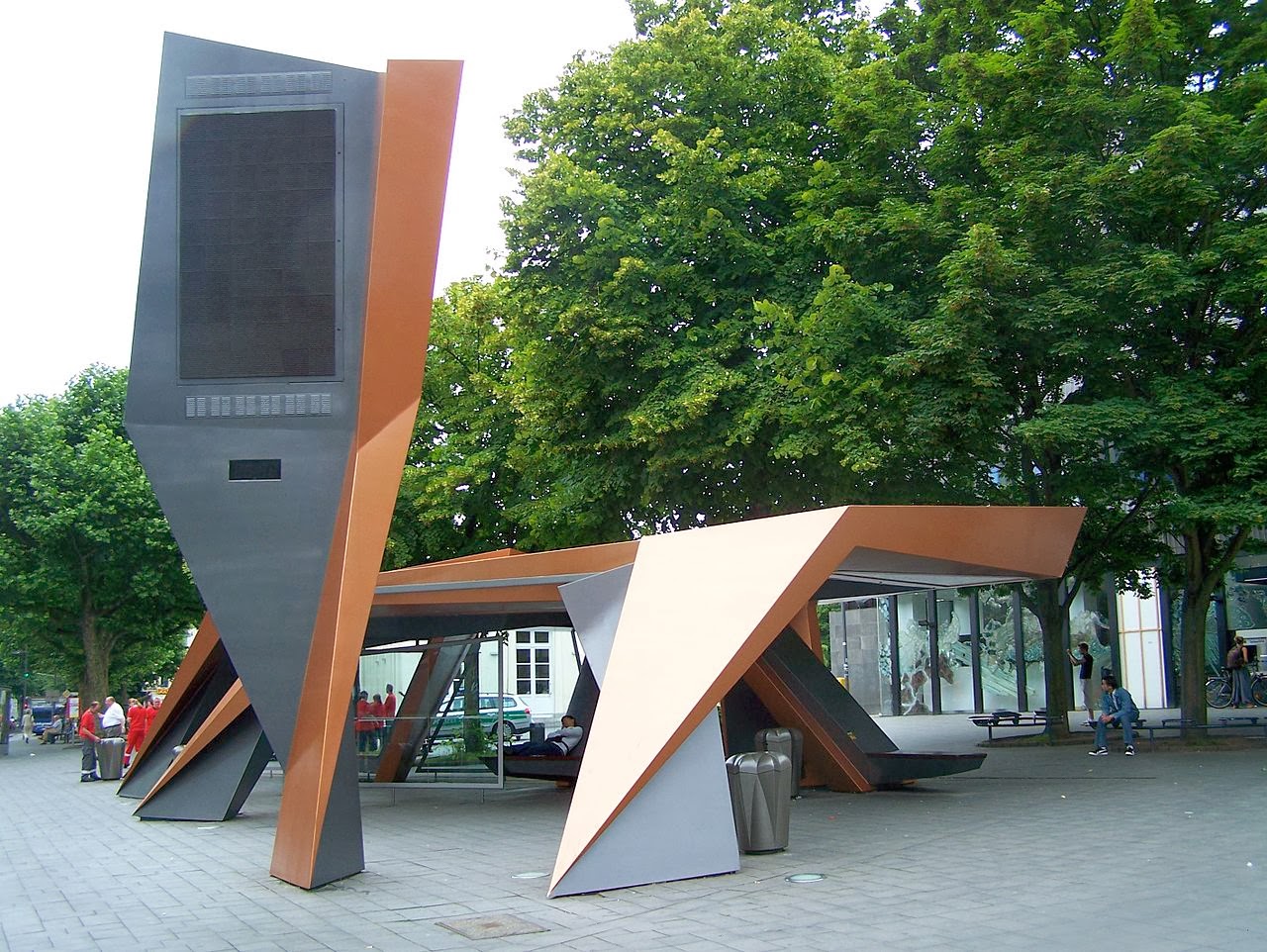


Bus Shelter by Peter Eisenman


Le Corbusier House


Japanese Architecture

Ito was inspired by many designers including Le Corbusier, Ray and Charles Eames, Mies Van Der Rohe, Frank Lloyd Wright, Peter Eisenman and also Japanese architecture. 


Referencing :

ArchDaily. 2008. Toyo Ito. [ONLINE] Available at: http://www.archdaily.com/tag/toyo-ito/. [Accessed 20 January 14].
http://www.allposters.com/-sp/Serpentine-Gallery-Pavilion-2002-Kensington-Gardens-London-Architect-Toyo-Ito-with-Arup-Posters_i7180251_.htm

AllPosters.com. 2009. Serpentine Gallery Pavilion 2002, Kensington Gardens, London, Architect: Toyo Ito with Arup . [ONLINE] Available at: http://www.allposters.com/-sp/Serpentine-Gallery-Pavilion-2002-Kensington-Gardens-London-Architect-Toyo-Ito-with-Arup-Posters_i7180251_.htm. [Accessed 20 January 14].

ArchDaily . 2008. Flashback: Sendai Mediatheque / Toyo Ito. [ONLINE] Available at: http://www.archdaily.com/118627/ad-classics-sendai-mediatheque-toyo-ito/. [Accessed 20 January 14].

THE POWER ROOM LLC. 2014. POWER CREATIVES: LE CORBUSIER: THE ARCHITECT BEHIND KANYE WEST’S ‘YEEZUS’ PROJECT. [ONLINE] Available at: http://www.thepowerroom.com/le-corbusier-the-architect-behind-kanye-wests-yeezus-project/. [Accessed 20 January 14].

RIBA. 2006. Tower of Winds, Japan. [ONLINE] Available at: http://www.architecture.com/awards/royalgoldmedal/royalgoldmedal2006/towerofwinds.aspx#.UuS6h3mCq2w. [Accessed 20 January 14].

WordPress. 2014. Something Interesting. [ONLINE] Available at: http://blog.futonstorenyc.com/japanese-architecture-modern-buildings/. [Accessed 20 January 14].


Alessi


Alessi is a kitchen utensil company from Italy. Alessi was founded in 1921 by Giovanni Alessi. It is 
a company which embodies a typical phenomenon of Italian industrial culture.

Alessi first began in a workshop in Valle Strona near lake Orta in the Italian Alps near Switzerland. This area was also known for its traditionally in creating small objects of wood and metal for the house and in the kitchen in general. Alessi started to produce a wide range of table ware items in nickel, chromium and silver-plated brass. The company produced hand made products with the aid of machines.

The Alessi company began to gain a foothold after Giovanni Alessi’s father Carlo joined the company. Carlo was trained as an industrial designer where he virtually developed all of the products which appeared in the catalogues between 1935 and 1945. In the 1950s father replaced his grandfather as corporate general manager, giving up his role of a designer and increasingly relying on the contributions of freelance designers. In 1957 Luigi Massoni designed salt and pepper shakers, and Ice bucket and Ice tongs as part of the Program 4 for II triennial in Milan.


Luigi Massoni designed salt and pepper shakers, and Ice bucket and Ice tongs in 1957.


Alessi products are still considered to be handicraft items made with the aid of machines. They say that their products are still being considered as handicraft because they want to stick to the culture.

In 1970 Alberto Alessi was responsible for the third transformation of the company. The Alessi company was in Alberto Alessi’s leadership together with some help of maestro designers including  Achille Castiglioni, Richard Sapper, Alessandro Mendini and Ettore Sotsess, whom are now important designers who contributed in the seventies. In the 70s Alessi produced the Condiment set (salt and pepper and toothpicks) by Ettore Sotsess, and the Espressomaker by Richard Sapper. The 1980s marked a period in which Italian design factories had to compete with mass production. Alessi also introduced new designers like Aldo Rossi, Michael Graves and Philippe Starck.


Philippe Stark - Lemon Juicier 


Espresso Maker by Aldo Rossi


Bird Kettle - Michael Graves


 Espresso Maker by Richard Sapper


Modern electric Espresso Maker 


Achille Castiglioni - cutlery set 


The Alessi company started to introduce the plastic material in the 90s. This gave the designers freedom in their designs. Stefano Giovannoni and Alessandro Mandini designed the Fruit Mama. During the 2000s Alessi collaborated with several architects for the coffee and tea towers, introducing a new generation of architects such as Weil Arets, Zaha Hadid, Toyo Ito, Grey Lynn, MRVDV, Jean Nouvel and UN studio.


Guido Venturini - Gino Zucchino


Alessandro Mendini by Corkscrew


Alessi products are on display in museums worldwide like Museum of Modern Art in New York, Metropolitan Museum of art, Victoria and Albert Museum, Pompidou Centre and Stedelijk Museum Amsterdam.


We can see that the Alessi company left a great impact on the house hold goods, they made a very good development on the tool and there only mission was that the products that they made were ergonomically correct for the human body. They even eliminated the decoration from there designs to became minimal and neutral. 


Referencing :


Sol Cabanas. 2013. Pintrest. [ONLINE] Available at: http://www.pinterest.com/pin/461548661781087981/. [Accessed 20 January 14].

Panik Design. 2001. Panik. [ONLINE] Available at: http://www.panik-design.com/acatalog/Alessi_-_Luigi_Massoni_-_Ice_Bucket_Polished.html. [Accessed 20 January 14].

Richmond Cookshop. 2005. Richmond Cookshop. [ONLINE] Available at: http://www.richmondcookshop.co.uk/product_info.php?products_id=1772. [Accessed 20 January 14]

MetaFilter Network Inc.. 1999. MetaFilter. [ONLINE] Available at: http://www.metafilter.com/60893/From-whence-the-spork. [Accessed 20 January 14].

Alessi. 2003. Alessi. [ONLINE] Available at: http://www.alessi.com/en/company/storia. [Accessed 20 January 14].


Ergonomic Design

Ergonomics is about designing for people, wherever they interact with the products. Usually, people don't notice good design unless it is exceptional. Normal people notice poor design. Ergonomic design is there to compliment the strengths and abilities of people and minimise the effects of their limitations, rather than forcing them to adapt to the surroundings.

Many designers are designing for people in need for people in the third world countries.
In the picture above we can see poor people using a very good innovative design which is a foot paddle washing machine. They can also carry water with this device. Hence it will be easier to walk back home without water containers on their heads.


 An other good idea is the last part of the bicycle with a dynamo attached to it. The dynamo was frequently used in the past when batteries did not exist yet and it had light attached to it. This works in a similar way but instead it has a mobile charger attached to it.


Door knobs were invented a long time ago in about 1870s in the United States. Although this was a  good invention at that time, it had to develop further because people with hand disabilities couldn't open the door by using its knob. As a result many years later the door handle was invented.


As we can see in this picture of the door handle an LED is fixed into the door handle so when the lights are switched off one can see it immediately.


The men’s razor blade was evolved throughout these years. First it consisted of one blade with two opposite tips, which made it disposable. The disposable blades were more protective and more hygienic because one could use it one time and throw it away. However, today electric razors became popular where you buy one and use for many more times than the disposable ones. 


 Old man razor.


The Gillette evolution of man´s razor blades.


Electric razor for man.


Even the ice cream scoop was developed so it could be easier to use. The last ice cream scoop which was designed by Karl Urlich, is the most ergonomically correct with humans.


Ice cream scoop by Karl Urlich


Old mouse and keyboard with few ergonomic functions.


Also, technological equipment usually gets improved by designers when seeing the criticism of the public such as the old mouse and keyboard which were ergonomically incorrect.


Additionally, the scissors had to be arranged due to the fact that left handed people had a problem when using normal scissors since it was designed for right handed persons. Now scissors were invented in order to meet the need of both left and right handed people.


Referencing :

HyunJu Kim. 2013. Lifestraw. [ONLINE] Available at: http://cklist.egloos.com/5058930. [Accessed 20 January 14].

jamesrobertwatson. 2000. Design for the other 90%. [ONLINE] Available at: http://www.jamesrobertwatson.com/other90.html. [Accessed 20 January 14].

Thermoformable 3000 . 2013. vivadia. [ONLINE] Available at: http://www.thermoformable-3000.com/ciseaux-fiskars-softouch-p-367.html. [Accessed 20 January 14].

Yanko Design. 2014. LEDoorHandle . [ONLINE] Available at: http://www.yankodesign.com/2011/08/03/enchanting-doorlight/. [Accessed 20 January 14].


Environmental Design

Billions of plastic bottles are thrown away every year. Firstly, the bottles go to a recycling centre where they are shredded. Then they are boxed and shipped all over the world. Normally, the Chinese textile industry uses a lot of these materials for their clothing. Next, the plastic is sorted according to the colour because through transparent plastic, white cloth or material which can be dyed can be produced. Then the stickers and lids are removed. After, the plastic are washed and made into more coloured plastic. Anther step is needed where the plastic is put into a tube at a temperature of 200°C and it turns into thread. It must be stretched and combined at this stage when it is still heated because the fibres are bound together. After this process it is torn apart as fluff similar to the texture of wool but actually it forms polyester. The material is strengthened with more processes and finally it becomes ready to be tied. It is collected in machines that work like a spider by making small loops. After the material is given to factories they try not to waste material by producing usable stuff.


Designed dress from recycled materials.


Bamboo plants are becoming very popular in Chinese forests. A bamboo plant can grow almost 1 metre a day. They are emerging in the South West of China all the to Shan-Ki. This is the reason why environmental design is encouraging designers to use bamboos for their furniture because we are cutting too many trees and the rate of deforestation is exponentially growing. 


 Chinese Bamboo


Outdoor bench made from bamboo

Bamboo is also being used for out door furniture and swimming pool areas because its water proof / water resistant. 


Green buildings are also known as sustainable buildings meaning that processes are environmentally responsible and resource-efficient. This work must be done together with the architect, engineer and the people who are going to use the building. Green buildings must be economical, utilised, durable and comfortable. New technologies are being developed then added to these buildings. The principal things needed for green buildings are designed to reduce the overall impact of the built environment, health and the natural environment by using efficient energy, water and other resources, treating occupant health and improving employee productivity and also reducing waste.


This is the Adobe building in the U.S, it is one of the most economical buildings.


Referencing : 

Zululand Marketing. 2014. Zululand. [ONLINE] Available at: http://www.zululand.co.za/blog/environmental-conservation/funky-bamboo-furniture/. [Accessed 20 January 14].

Hansgrohe Group. 2013. Hansgrohe Group. [ONLINE] Available at: http://www.hansgrohe-int.com/9662.htm?gclid=CLTs5_awmbwCFUi33godKHEAdA. [Accessed 20 January 14].

Doug L. James,. 2007. Twenty-First Century Waterfall. [ONLINE] Available at: http://www.cs.cornell.edu/~djames/bottledwater/. [Accessed 20 January 14].

FBF Family Before Fortune. 2014. FBF Family Before Fortune. [ONLINE] Available at: http://www.familybeforefortune.com/blog/the-chinese-bamboo/. [Accessed 20 January 14].


Wednesday, 8 January 2014

Renzo Piano - Post Modern : Task 2


Renzo Piano


Renzo Piano born in Genoa, Italy in 1937. He studied at the Milan Politecno 1959-1964, where he taught until 1968. Renzo Piano fascinated himself with the interrelationship between the structural components of construction was sparked from an early age. Renzo established a partnership with the English architect Ricard Rogers in 1970. 

Renzo Piano and Richard Rogers designed a number of buildings in Italy and England but their most famous building is the Pompidou Centre in Paris. This was all colour coded service elements emphasised on the buildings exterior. The public opinion has shifted since this building was finished. Today the city is celebrating for it boldness and widely regarded as one of the city´s most permanent contemporary landmarks.


Pompidou Centre in Paris by Renzo Piano and Richard Rogers


 Renzo Piano is known as one of the members of the ‘‘High Tech’’ movement because he included technology as a starting point for the designs. He made many attempts to generate an architecture character based on technological forms for more comfortable and people with special needs.


When Richard Rogers left the group to setup his own practice in 1977 Renzo Piano continued to work with Peter Rice which he was an engineer. In 1981 Renzo Piano founded the Renzo Piano Building Workshop, he started to practice but now it employs around 150 people in office across the world in Paris, New York City as well in Genoa, Italy which is his home town.

Renzo Piano had started a controversy just after the fall of the Berlin Wall. This gave him a master plan for the new Potzdamer Platz in Berlin. The project was criticised for its lack of regard to the history of the site.


He also took some inspiration from Rietveld´s Schröder House, he designed it with many windows so natural light comes in and less energy is used.


Schröder House by Gerrit Rietveld


 In his recent work Renzo Piano started to use his structural experiments to a range of social and civic projects. It also included the expansion of the Art Institute of Chicago, the Modern Wing and Europe´s tallest skyscraper The Shard in London. He is one of the greatest architect of his generation, so the AIA gave him the honour with its recent announcement that the American Institute of Architects 2008 Gold Medal is going to Renzo Piano the Italian architect. This work looks Beautiful and it internets with the seem of nature with technology. 


He also designed our Maltese Parlament and ‘‘Bieb il-Belt’’ in Malta although it is under construction we can see that he managed to combine the old historical buildings in Valletta which were built by the Knights of Saint John and the two new contemporary buildings.


Maltese Parlament 


Referencing :


Renzo Piano. 2002. Arc Space. [ONLINE] Available at: http://www.arcspace.com/features/renzo-piano-/. [Accessed 06 January 14].


Richard Rogers Ltd. 2000. Centre Pompidou. [ONLINE] Available at: http://www.richardrogers.co.uk/work/buildings/centre_pompidou/completed. [Accessed 06 January 14].

Artifice.Inc. 1994. Renzo Piano. [ONLINE] Available at: http://www.greatbuildings.com/architects/Renzo_Piano.html. [Accessed 06 January 14].

McGraw Hill Financial. 2014. Architecture Record . [ONLINE] Available at: http://archrecord.construction.com/news/2011/06/110629-Stavros-Niarchos-Cultural-Center.asp. [Accessed 06 January 14].

Nasher. 1998. Nasher Sculpture Centre. [ONLINE] Available at: http://www.nashersculpturecenter.org/Building-and-Garden/Renzo-Piano. [Accessed 06 January 14].

ArchDaily . 2008. AD Classics: Rietveld Schroder House / Gerrit Rietveld. [ONLINE] Available at: http://www.archdaily.com/99698/ad-classics-rietveld-schroder-house-gerrit-rietveld/. [Accessed 06 January 14].